
Online Gaming: Building Social Skills in Kids
Explore how online gaming like Fortnite and Minecraft fosters social skills in kids. Discover the benefits of teamwork, communication, and empathy, along with tips for parents to manage risks like cyberbullying and screen time.
2/23/20267 min read
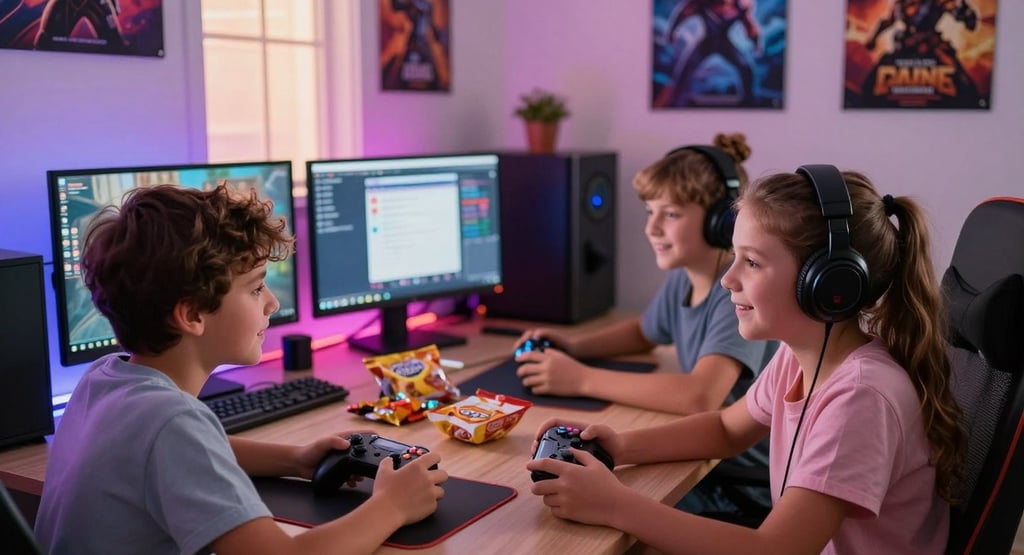
The Rise of Online Gaming and Its Impact on Social Interaction
Kids aren't just playing; they're meeting, teaming up, and forming real friendships — and that's a big part of the social impact of online gaming today. The popularity of online gaming has surged over the past years, especially among children and teenagers, turning many video games into lively social spaces. For example, recent surveys (see sources like Common Sense Media and Pew Research) show a very high share of young people — often cited around the high double-digits — who play video games, and a large portion of that time is spent in multiplayer online modes.
Online games encourage team-oriented play where players cooperate to reach shared goals. Titles such as "Fortnite," "Minecraft," and "Among Us" are familiar examples that mix competition with collaboration and invite players to strategize, trade tips, and solve problems together. These games create multiple channels for communication — in-game chat, voice, and community hubs like clans or guilds — that help game players practice teamwork, leadership, and problem-solving in a low-stakes setting.
Social platforms have amplified those connections. Services like Discord and Twitch give gamers a place to stream video content, coordinate sessions, and chat before, during, and after play. That added layer of interaction helps many players feel part of a community: they share clips, celebrate a win, or ask for help — actions that build friendships and a sense of belonging across time zones and countries.
Researchers have begun to document how these interactions affect social development. Some studies find that children who regularly play online with peers show gains in certain social skills compared with less-engaged peers, though results vary by age, game type, and context. For many youngsters, an online game is more than entertainment — it's a place to practice communication, make friends, and learn how to get along with others in a digital world.
Below, we look at how those online friendships compare with face-to-face relationships and what benefits — and risks — parents and educators should watch for.
Building Online Friendships: Similarities and Differences to In-Person Relationships
Video games often spark friendships the same way playgrounds or school clubs do: people meet around a shared interest. Many players bond over a favorite online game, trade tips, and spend hours strategizing together — and those shared experiences can quickly feel like the foundation of a real relationship. In multiplayer online settings, teamwork and common goals act as social glue, whether teammates are coordinating a raid in a massively multiplayer title or planning a quick tactic in a competitive match.
Communication is the engine of these bonds. Players use voice chat, text messages, direct messages, and stream comments to talk in real time. Common tools include in-game chat, Discord servers, Twitch chat, and private DMs — all places where people coordinate, joke, and comfort one another. That said, online communication misses many nonverbal cues: you won't see a friend's facial expression or body language, and sarcasm or tone can easily be misunderstood. Those gaps sometimes lead to friction, but many gamers learn simple strategies — clear instructions, short check-ins, and calm private messages — to avoid conflict and keep teams working well.
Online friendships can still provide real emotional support. Gamers across countries report relying on teammates for encouragement during stressful times, school pressure, or personal setbacks. For example, a teenager who met teammates through a cooperative game might join a study group organized by fellow players from different time zones, turning an in-game alliance into a steady support network. Those stories show how friendships formed in games can mirror the emotional depth of offline relationships, even if the way people show care looks different.
Quick tips for clearer in-game communication: 1) Use short, specific calls (e.g., “Rush left, I’ll cover”), 2) If things get heated, move the conversation to a private message, 3) Confirm understanding with a quick “Got it?” or emoji. These small habits help players translate teamwork and empathy from virtual matches into stronger friendships, and they teach communication skills that transfer into other parts of life.
Next: we’ll explore how those friendships help kids develop social skills — and what parents should watch for as those digital relationships grow.
The Benefits of Online Friendships for Kids' Social Skills Development
Online friendships and the social benefits they bring are an important part of many children's development today. Playing a video game with others gives kids repeated practice in communication: they describe plans in chat, call out positions over voice, and explain strategies on the fly. That practice helps children build clearer language skills and confidence in speaking up — abilities that transfer to school presentations, group projects, and everyday conversations.
Key benefits at a glance:
• Communication — Regular in-game talk (text, voice, or short video clips) helps children learn to give concise instructions, ask for help, and negotiate plans. A simple classroom tip: ask kids to explain a game strategy aloud to practice sequencing and clarity.
• Teamwork and problem-solving — Many online games require roles, timing, and cooperation. Games that emphasize multiplayer objectives encourage negotiation, turn-taking, and shared responsibility. For example, coordinating a squad in a cooperative match teaches kids to plan, assign tasks, and adapt when plans change — all practical teamwork skills.
• Cultural exposure and empathy — Online games connect players around the world, exposing children to different accents, traditions, and perspectives. Those interactions can broaden world views and foster empathy by showing that people from other places share similar interests and feelings.
• Emotional intelligence — Navigating wins, losses, and conflicts in a game gives kids low-stakes opportunities to practice managing emotions, offering encouragement, and resolving disagreements. Researchers note that these repeated social exchanges can strengthen children's ability to read emotions and respond appropriately over time.
Real-world examples make these benefits clearer. A parent in New York reported that her 12-year-old learned leadership skills by organizing weekly sessions with a small group of friends from three countries; another teacher used collaborative game tasks to spark better classroom teamwork. While not every child will gain the same skills, these stories show how online games and online gaming communities can support social growth.
What parents and educators can try: encourage brief debriefs after play (ask: “What did you plan? What worked?”), set small cooperative challenges that require role assignment, and model calm conflict resolution when disagreements happen. These simple habits turn in-game interactions into learning moments that strengthen relationships and life skills.
Those gains exist — but they're not automatic. Next, we’ll cover potential risks parents should watch for and practical ways to keep gaming healthy and safe.
Potential Challenges and Risks of Online Friendships in Gaming
Online friendships formed through gaming bring real social benefits, but they also come with risks parents and educators should take seriously. One of the most common problems is cyberbullying: players can face insults, exclusion from matches, or coordinated harassment across platforms. Because gaming conversations often follow players into streaming chats, Discord servers, or social media, harmful interactions can feel inescapable and affect a child's mental health.
Excessive use of games is another concern. When kids spend many hours a day in an online game, other parts of life — homework, sleep, sports, and face-to-face friendships — can suffer. Rather than labeling this "addiction" in every case, it's more useful to watch for patterns: quiet withdrawal, falling grades, lost interest in other activities, or major shifts in mood. If you see those signs, consider a conversation and, if needed, professional support.
There’s also the problem of misleading online personas. Game players may misrepresent age, intent, or identity, and that creates risk for younger children who share personal details or agree to meet offline. Teaching kids basic safety — never sharing home address, school, phone number, or other identifying information — is crucial. Parents should also help children recognize red flags, like someone who pushes for private chats or asks many personal questions too soon.
Practical parent checklist:
• Set time boundaries: agree on daily or weekly hours for gaming and stick to them (short, consistent limits are easier to enforce than sudden bans). • Use privacy and parental controls on consoles, platforms, and apps to restrict voice chat or unknown friend requests. • Co-play occasionally or watch a short video of your child’s game to understand who they play with and how they interact. • Teach safety rules about personal information and what to do if someone makes them uncomfortable. • Keep an open, nonjudgmental line of communication — start with, “Tell me about the people you play with,” rather than immediate punishment.
Watch for mental health warning signs: persistent sadness, sleep loss, sudden irritability after gaming sessions, or talk of being targeted by others. If those signs appear, talk with your child and consider reaching out to a school counselor or pediatrician — researchers find early, calm conversations often help more than punitive measures.
Tools and small habit changes can help keep gaming healthy. Try scheduling “game-free” family time during the week, use built-in screen-time apps to limit hours, and encourage offline activities that reinforce social skills learned online. For families in need of guidance, reputable resources like Common Sense Media or the American Academy of Pediatrics offer up-to-date advice and platform-specific settings.
Balancing the social benefits of online gaming with these risks means being informed, setting consistent limits, and keeping conversations open. In the next section we’ll wrap up with a short conclusion and practical next steps for parents, teachers, and gamers.
Conclusion: Balancing the Social Benefits and Risks of Online Gaming
Online gaming and online games clearly shape how many children and teens make friends, practice communication, and learn teamwork. The social impact of online gaming stretches beyond play: game players build skills, form communities, and find emotional support through shared video and multiplayer experiences that cross borders and time zones.
At the same time, parents, educators, and gamers should be mindful of risks like cyberbullying, excessive hours, and misleading online personas. Practical steps — set consistent time limits, use platform privacy settings, co-play sometimes, and keep open conversations — help protect mental health and keep relationships healthy. Researchers stress that guidance and context matter: with limits and support, the benefits often outweigh the harms.
If you’re a parent or teacher, start small: check privacy controls on a favorite video game or app, agree on weekly hours, and ask a child to tell you about a friend they play with. For gamers, remember to take breaks, keep offline friendships alive, and reach out if someone’s behavior feels wrong. Most importantly, remember that many young people find real comfort and friendship in games — with a little guidance, those connections can be a positive part of life.
And just as online gaming communities have shown me the power of connection and support, I'm committed to paying that support forward in my own life. A portion of the proceeds from items purchased through the Amazon affiliate links or charitable links below will be donated toward eradicating Parkinson's disease — a condition I was diagnosed with in 2017 and continue to battle today.
Your engagement with this content and any purchases made through these links directly contribute to research and treatments that bring us closer to a cure. It's a reminder that whether we're teaming up in a virtual world or coming together for real-world causes, every connection and contribution matters.
The article above contains affiliate links. If a purchase is made through these links, the author may receive a small commission.